
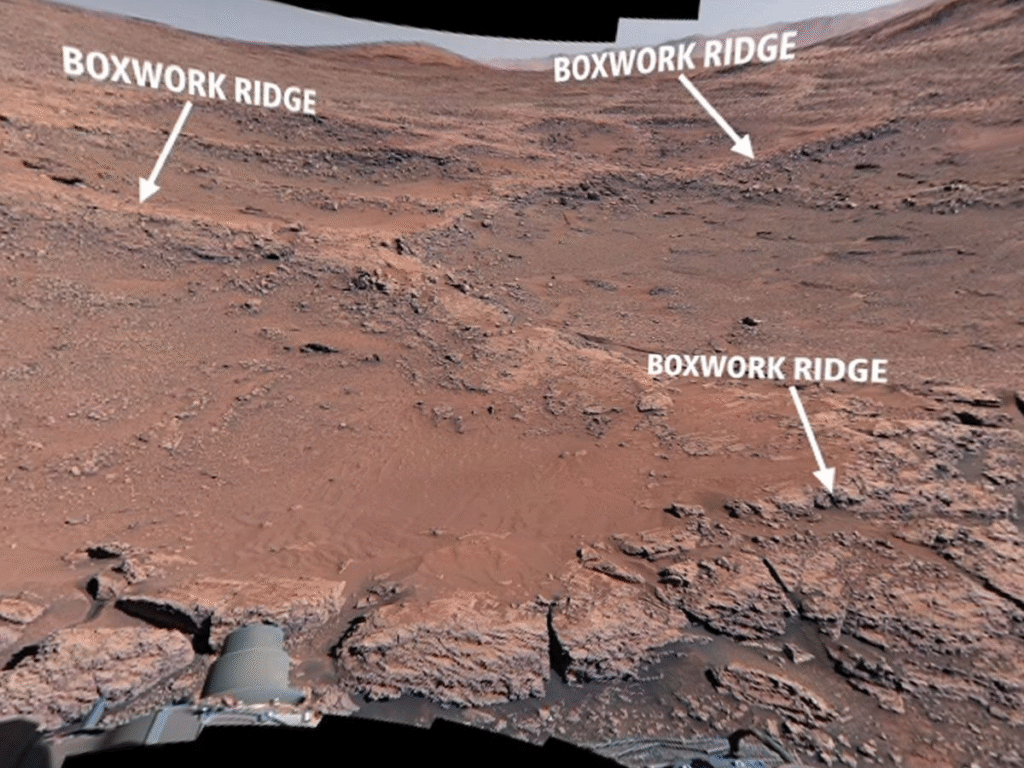
A hilly landscape that looks like spiderwebs when viewed from orbit is offering new clues about the history of water on ancient Mars. For nearly six months, NASA’s rover Curiosity has been exploring a region filled with unusual geologic formations known as boxwork. These low ridges, standing 3 to 6 feet (1 to 2 meters) tall, with sandy hollows in between, crisscross the Martian surface for miles.
The formations suggest that ancient groundwater flowed across this part of the Red Planet far later than scientists once believed. This discovery raises powerful new questions about how long microbial life could have survived on Mars billions of years ago — long after rivers and lakes dried up, leaving behind a cold desert world.
From space, the boxwork ridges resemble giant spiderweb patterns. Scientists believe groundwater once moved through fractures in the bedrock, leaving behind minerals that hardened into ridges. Areas without mineral reinforcement were gradually eroded by wind, forming the hollows seen today. Until Curiosity arrived, researchers could only speculate about what these formations truly looked like up close and how they formed.
Unpacking the Mystery of Boxwork
Although similar boxwork ridges exist on Earth, they are rarely more than a few centimeters tall and are typically found in caves or dry sandy regions. On Mars, however, these formations are massive and dramatically larger, presenting a major engineering challenge.
Driving the nearly one-ton rover across narrow ridge tops required precise navigation and careful planning. According to NASA engineers, some ridges felt like natural highways, but descending into sandy hollows carried risks of wheel slippage and mobility issues.
The region lies on Mount Sharp, a 3-mile-tall (5-kilometer-tall) mountain that Curiosity has been climbing for years. Each layer represents a different era of Mars’ changing climate history. As the rover ascends, the terrain increasingly shows signs of a planet gradually drying out, interrupted by occasional wet periods when rivers and lakes briefly returned.
Scientists say discovering boxwork this high on the mountain suggests the groundwater table once stood much higher than expected. This strengthens the possibility that life-sustaining water may have lasted longer than previously believed.
Earlier orbital imagery revealed dark lines crossing the spiderweb formations. In 2014, scientists proposed these were central fractures formed by groundwater seepage. Curiosity’s close-up investigation confirmed that these lines are indeed fractures filled with mineral deposits, supporting the groundwater theory.
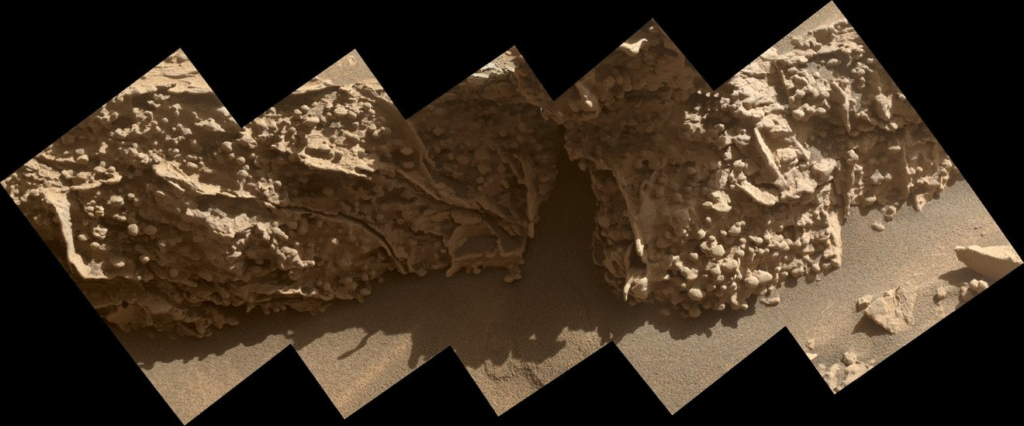
The rover also discovered bumpy textures called nodules, clear evidence of past groundwater activity. Surprisingly, these nodules appeared along ridge walls and hollows rather than near the central fractures. Scientists are still working to understand why the nodules f
ormed in those specific areas.
Curiosity: A Roving Laboratory on Mars
A crucial part of the mission involves drilling into rocks and analyzing powdered samples using onboard instruments. Recently, four samples from the boxwork region were studied. X-ray analysis revealed clay minerals in ridge samples and carbonate minerals in hollow areas, offering further insight into Mars’ watery past.
One especially important sample underwent “wet chemistry” analysis, a specialized technique designed to help detect organic compounds — carbon-based molecules essential for life. This advanced testing makes it easier to identify chemical signatures that could hint at ancient habitability.
Soon, Curiosity will move beyond the boxwork formations into a sulfate-rich layer of Mount Sharp, created as Mars continued drying out billions of years ago. The rover will continue exploring this region in the coming year, helping scientists better understand how Mars transformed from a potentially habitable world into a frozen desert planet.
Built by NASA’s Jet Propulsion Laboratory and managed by Caltech, Curiosity remains at the forefront of humanity’s search for ancient life on Mars — uncovering powerful new evidence with every mile it travels.
FAQs
#Mars #CuriosityRover #NASAMars Carrerbook #Anslation #RedPlanet #MarsExploration #SpaceDiscovery #AncientMars #WaterOnMars #LifeOnMars