
In a rare and historic decision, NASA announced the early return of four astronauts from the International Space Station (ISS) following a medical issue involving veteran astronaut Mike Fincke.
The unexpected development marked the first-ever medical evacuation from the ISS, drawing global attention to astronaut health and emergency preparedness in space.
What Happened in Space?
During preparations for a planned spacewalk on January 7, Fincke experienced a medical event that required immediate attention from his fellow crew members.
In a public statement released on February 25, Fincke said:
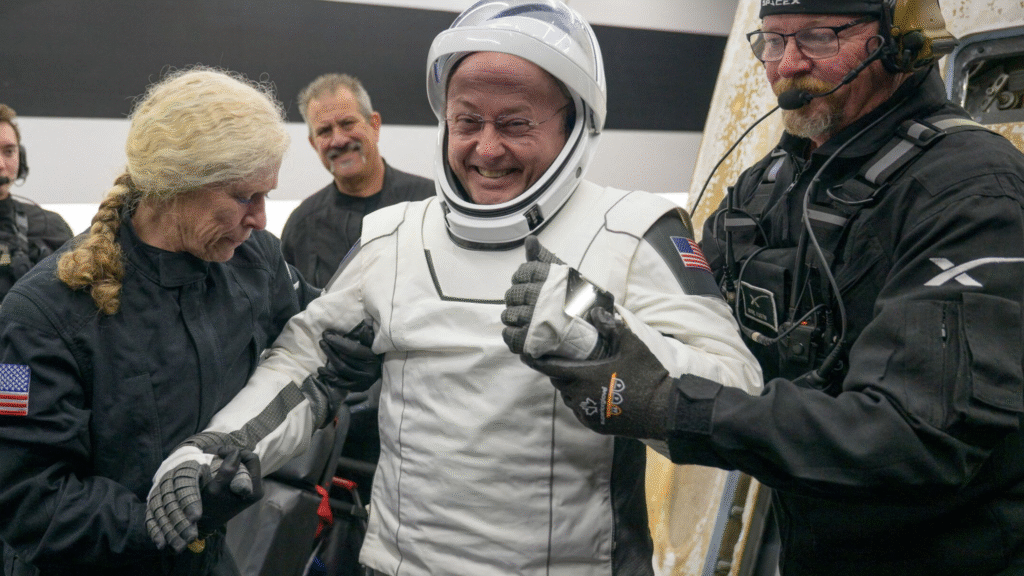
“I experienced a medical event that required immediate attention from my incredible crewmates.”
Although NASA clarified that the situation was not classified as an emergency, the condition required advanced medical imaging unavailable aboard the ISS.
As a result, NASA made the precautionary decision to end SpaceX’s Crew-11 mission early and bring the astronauts safely back to Earth.
Who Was on Crew-11?
The Crew-11 team included:
- Mike Fincke (NASA) – Pilot & Expedition 74 Commander
- Zena Cardman (NASA)
- Kimiya Yui (JAXA – Japan)
- Oleg Platonov (Roscosmos – Russia)
The crew returned aboard Crew Dragon Endeavour, splashing down safely in the Pacific Ocean near San Diego on January 15 — nearly a month earlier than planned.
Life Aboard the ISS After the Evacuation
Following Crew-11’s departure, the ISS temporarily operated with a skeleton crew of three astronauts:
- Chris Williams (NASA)
- Sergey Kud-Sverchkov
- Sergey Mikayev
They continued essential research and station maintenance while NASA and SpaceX accelerated the launch schedule for the replacement crew.
Medical Facilities on the International Space Station
The International Space Station (ISS) is equipped with essential medical support systems, but it is not a fully functional hospital. Astronauts have access to ultrasound technology, basic diagnostic tools, and real-time telemedicine support from Earth, allowing flight surgeons to guide medical procedures remotely. These systems are effective for monitoring health conditions and handling minor medical issues in orbit.
However, the station does not have advanced imaging equipment such as MRI or CT scanners. These machines are too large and complex for space deployment. When a condition requires detailed internal imaging or specialized treatment, returning to Earth becomes the safest and most reliable option.
Why This Incident Highlights Critical Preparedness
This event demonstrates the importance of comprehensive crew medical training. Astronauts are trained to respond to medical situations, assist crewmates, and stabilize patients until further action can be taken.
It also underscores the value of strong emergency response planning and rapid coordination between international space agencies, including NASA, JAXA, Roscosmos, and private partners like SpaceX.
Reliable spacecraft capable of safe and quick return to Earth are a crucial part of astronaut safety, ensuring that medical concerns can be addressed without delay.
Why This Event Is Historically Important
The incident marked the first-ever medical evacuation from the ISS, setting a precedent in human spaceflight operations. It showcased remarkable international cooperation and demonstrated how quickly agencies can coordinate in low Earth orbit during unexpected situations.
Most importantly, it reinforced a key principle of space exploration: astronaut health and safety always come first.
As future missions expand toward the Moon and Mars, managing medical risks in deep space — where immediate return is not possible — will become even more critical. Each event like this strengthens preparedness and advances the field of space medicine for long-duration exploration missions.
Frequently Asked Questions
1. What happened to Mike Fincke?
He experienced a medical issue that required advanced imaging on Earth. The exact condition has not been disclosed.
2. Was it a life-threatening emergency?
No. NASA stated it was not classified as an emergency but required precautionary return.
3. When did Crew-11 return?
The crew splashed down safely on January 15.
4. What spacecraft brought them back?
They returned aboard Crew Dragon “Endeavour.”
5. Did this impact ISS operations?
Temporarily yes, but Crew-12’s early launch restored normal operations.
The NASA astronaut medical emergency aboard the ISS serves as a powerful reminder that even in orbit, human health remains the top priority.
Thanks to advanced spacecraft technology, international collaboration, and rigorous astronaut training, what could have become a crisis was handled with professionalism and precision.
As humanity pushes further into space, events like this will shape the future of space medicine and long-duration missions.
#NASA #InternationalSpaceStation #ISS #SpaceX #Crew11 #AstronautHealth #Carrerbook #Anslation #SpaceMedicine #MedicalEmergency #HumanSpaceflight #SpaceExploration #SpaceNews #Aerospace #SpaceSafety